
Breaking the Flow: Understanding Baffle Tanks and Their Role in Liquid Transport
Breaking the Flow: Understanding Baffle Tanks and Their Role in Liquid Transport
When transporting bulk liquids, safety and stability are critical—especially when the cargo is in constant motion. One solution that addresses the challenges of liquid surge and imbalance during transit is the Baffle Tank. Designed with internal compartments that disrupt fluid movement, Baffle Tanks provide a practical advantage in liquid logistics—permitting transport of up to 80% filling and supporting heavy-density cargo without compromising safety.
What Is a Baffle Tank?
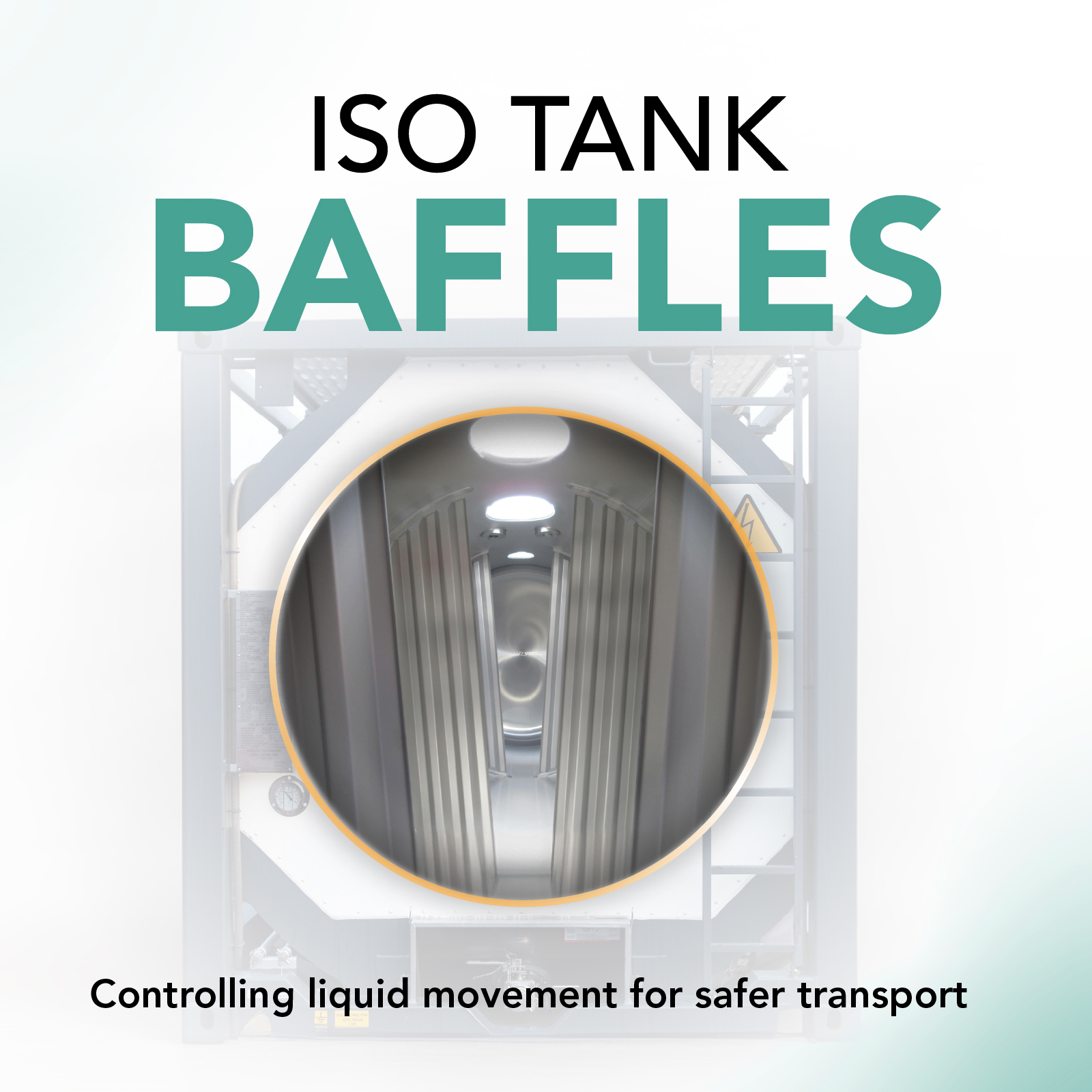
A Baffle Tank is a type of ISO tank container equipped with internal baffles—solid or perforated walls installed inside the tank. These baffles help control the surge or wave effect of the liquid as it moves during transportation. This is particularly valuable in situations involving frequent braking, turning, or acceleration, where uncontrolled liquid movement could compromise safety.
An added advantage is that Baffle Tanks can be filled up to 80% capacity, even with high-density liquids, unlike standard ISO tanks where fill limits may be lower due to surge risk.
Why Are Baffles Important?
Liquids are inherently mobile, and in a partially filled tank, they can shift rapidly in response to vehicle movement. This phenomenon—called liquid surge—can impact:
-
Vehicle stability
-
Braking efficiency
-
Cargo integrity
-
Driver safety
Baffles significantly reduce the surge effect by breaking up the liquid flow into smaller, more controlled movements. This makes handling easier and transportation safer, especially over shorter distances or in urban or hilly terrains where stop-and-go movement is common.
Additionally, baffles allow safe transport of heavy-density cargo by enhancing the tank’s internal stability and minimizing shift during transit.
Key Features of Baffle Tanks
-
Internal Baffle Design: Helps minimize fluid surge by creating barriers within the tank.
-
Improved Stability: Ensures better control and balance during transport.
-
Efficient Cleaning: Baffle configurations are designed to allow for effective tank cleaning post-transport.
-
Versatility: Suitable for various non-hazardous and certain hazardous liquids.
-
High Fill Ratio: Supports up to 80% fill level, making it ideal for denser cargo that needs volume flexibility.
Types of Baffle Tanks
Baffle Tanks can be categorized based on the orientation of the internal baffle walls:
1. Horizontal Baffle Tanks
-
Baffles run lengthwise across the tank.
-
Ideal for minimizing front-to-back surge during sudden stops or starts.
-
Commonly used in road transportation where acceleration and deceleration are frequent.
2. Vertical Baffle Tanks
-
Baffles are positioned vertically along the tank’s height.
-
Helps reduce side-to-side slosh.
-
More effective in applications with sharp turns or uneven terrain.
Each configuration has its benefits, and the choice between horizontal and vertical baffles depends on the type of cargo and route conditions.
Applications of Baffle Tanks
Baffle Tanks are commonly used across industries where liquid movement control is essential, including:
-
Food and Beverage: Transporting milk, edible oils, or juices.
-
Pharmaceuticals: Moving liquid APIs or solvents that require gentle handling.
-
Specialty Liquids: Handling high-value, sensitive liquids where even minor spillovers can result in losses.
-
Heavy Liquids: Transporting dense cargo like syrups or chemical slurries that benefit from the 80% fill capability.
Baffle Tanks vs. Non-Baffle ISO Tanks
| Feature | Baffle Tanks | Non-Baffle ISO Tanks |
|---|---|---|
| Surge Control | High | Low |
| Ideal for Partial Loads | Yes | No |
| Suitable for Short Trips | Yes | Yes |
| Cleaning Complexity | Moderate | Lower |
| Cargo Type Flexibility | High | Very High |
| Fill Level (Max.) | Up to 80% | ~70% or less |
| Heavy Cargo Compatibility | Excellent | Limited |
Conclusion
Baffle Tanks offer a critical advantage in controlling liquid surge during transport, making them an ideal choice for specific applications where safety and cargo stability are non-negotiable. With the added ability to fill up to 80% even for dense cargo, they provide a safer and more efficient option for bulk liquid logistics.
Understanding the role of horizontal and vertical baffles—and choosing the right tank configuration—can significantly improve the efficiency and safety of liquid logistics, especially when handling heavy or high-density products.
Blog By: