
Complete Guide to ISO Tank Codes
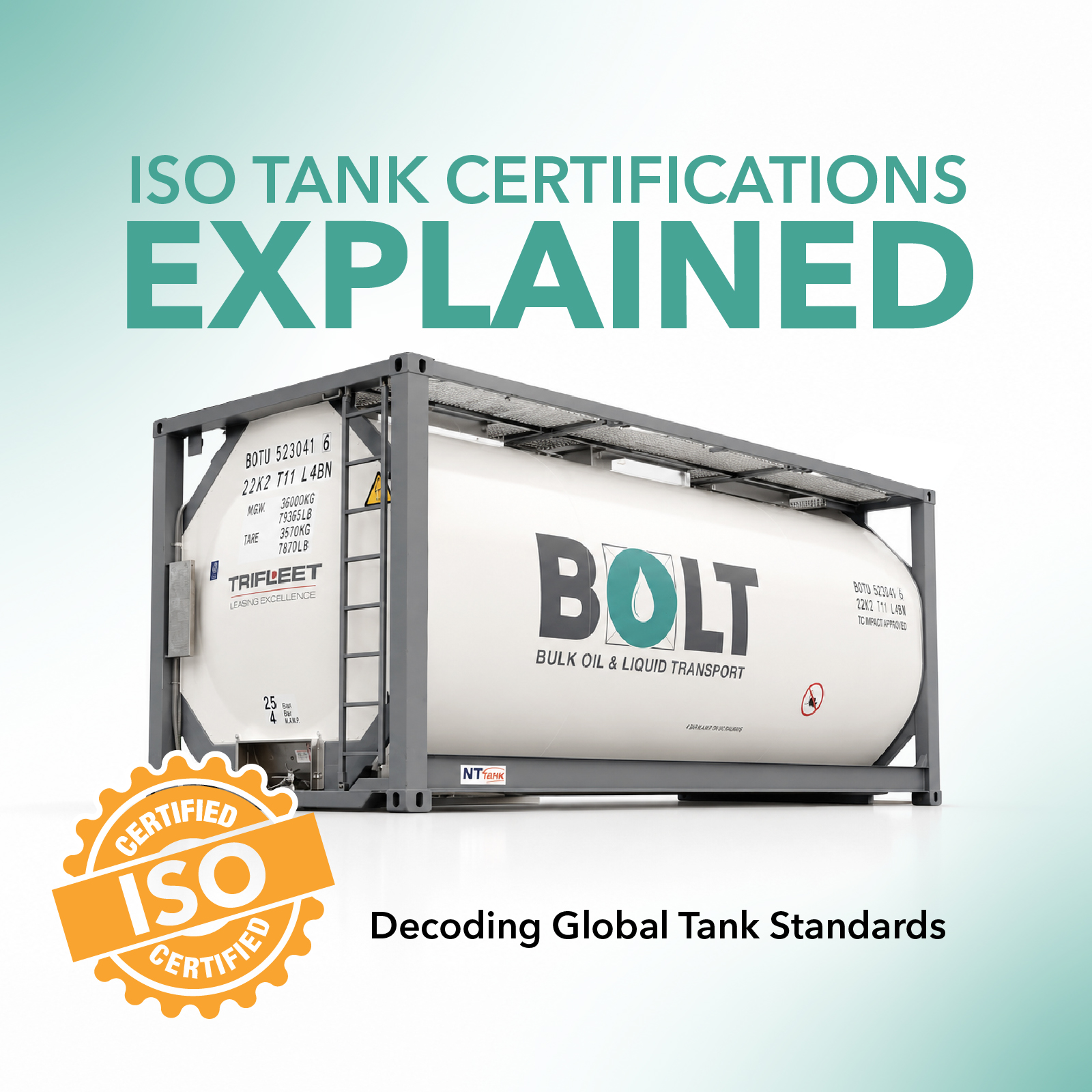
ISO tank codes (also called ISO Size–Type Codes) follow the ISO 6346 system: a compact, four-character identifier printed on every tank used in intermodal liquid logistics. Read correctly, the code instantly communicates the tank’s external size, tank category, and design/pressure capability — information that matters for safe loading, transport, inspection and regulatory compliance.
Below is a clear, industry-ready explainer you can use as a blog for BOLT.
What is an ISO Size–Type Code?
An ISO Size–Type Code is a four-character code displayed on the tank frame.
- First two characters (size code) — define external length and height.
- Last two characters (type code) — specify the tank design family and pressure rating / suitability for certain cargos.
These codes are governed by ISO 6346 and related standards (for tank design and testing) and are used alongside IMDG/ADR rules. Operators, depots and inspectors use these codes to match equipment to cargo and to verify compliance quickly.
Decoding the Size Code (first two characters)
- First character — length
- 2 = 20 ft (most ISO tanks are 20 ft long)
- Second character — height
- 2 = 8 ft 6 in (2591 mm) — standard height
- 5 = 9 ft 6 in (2896 mm) — high-cube
Width for ISO tanks is typically ~8 ft (2438 mm) unless otherwise specified. Common size codes you’ll see:
- 22 → 20 ft × 8′6″ (standard)
- 25 → 20 ft × 9′6″ (high-cube)
Decoding the Type Code (last two characters)
The type code shows the tank family and design/pressure category.
Primary letters used for liquid/gas tanks
- K — modern pressurised liquids/gases family (covers a wide range from non-regulated to gas tanks)
- T — older tank designation frequently used in tank/container classification (many T-codes map to common chemical tank designs)
- U — open-top or specialized containers (not used for gas in the same way as K8)
Note: Over time industry usage has aligned many older T-class references with K/N families; always check the tank plate for exact design data.
K-series breakdown (common practical interpretation)
- K0 — Non-regulated liquid tanks (food-grade or mild liquids)
- K1 — Dangerous goods with ≤ 2.65 bar design pressure (low pressure chemicals)
- K2 — Dangerous goods > 2.65 bar up to ≤ 10 bar (general chemical use)
- K3 — Dangerous goods > 10 bar (higher pressure liquids)
- K8 — Gas tanks / high-pressure gases
T-series in practice
- T3 – T6 — Liquid tank containers used for chemicals/hazardous cargo; pressure/design varies by numeric value.
- Example: T5 typically represents a design capable of medium pressure (often cited ~4 bar min).
- T6 generally maps to higher pressure designs (T14-like behavior in older nomenclature).
Common ISO Tank Code Examples:
|
Code |
Dimensions |
Type Description |
Typical Use Case |
|
22K0 |
20 ft x 8'6" |
Pressurised tank container (liquids and gases) |
Food-grade or mild liquids |
|
22K1 |
20 ft x 8'6" |
Pressurised tank container (liquids and gases) |
Low-pressure chemicals |
|
22K2 |
20 ft x 8'6" |
Pressurised tank container (liquids and gases) |
General chemicals |
|
22T5 |
20 ft x 8'6" |
Pressurised tank container (liquids tanks) |
Corrosive liquids, T11-like |
|
22T6 |
20 ft x 8'6" |
Pressurised tank container (liquids tanks) |
T14 equivalents |
|
22K8 |
20 ft x 8'6" |
Pressurised tank container (liquids and gases) |
High-pressure gases |
Note: UN T-codes (T11/T14) relate loosely via design but differ from ISO size-type codes.
Step-by-Step Decoding
Take 22T5 as an example:
-
First digit = 2 → 20 ft length.
-
Second digit = 2 → 8′6″ height.
-
Third character = T → Tank container family (chemical/hazardous liquid application).
-
Fourth character = 5 → Design/pressure category (medium pressure; chemical service).
Apply the same steps for any four-character code; use BIC/ISO tables or the tank’s data plate to confirm exact pressure ratings and fittings.
Why ISO Tank Codes matter
-
Prevent cargo-to-tank mismatches (critical for safety).
-
Support regulatory compliance under IMDG / ADR rules.
-
Guide depot maintenance, cleaning and testing intervals.
-
Help operators and shippers choose appropriate equipment for chemicals, pharma, food-grade and gases.
Always verify the tank plate (data/name plate) and the operator’s documentation for the definitive design pressure, test history and approvals.
Final notes & best practice
-
The four-character ISO Size–Type Code gives a fast, standardised snapshot — but it’s not a substitute for the tank data plate or technical documentation.
-
When in doubt about pressure limits, lining, fittings or cargo compatibility, consult the tank plate, the operator and the official BIC/ISO resources.
-
Use the code to shortlist equipment; always confirm the full technical specification before loading.